Podcast: UR Love Podcast
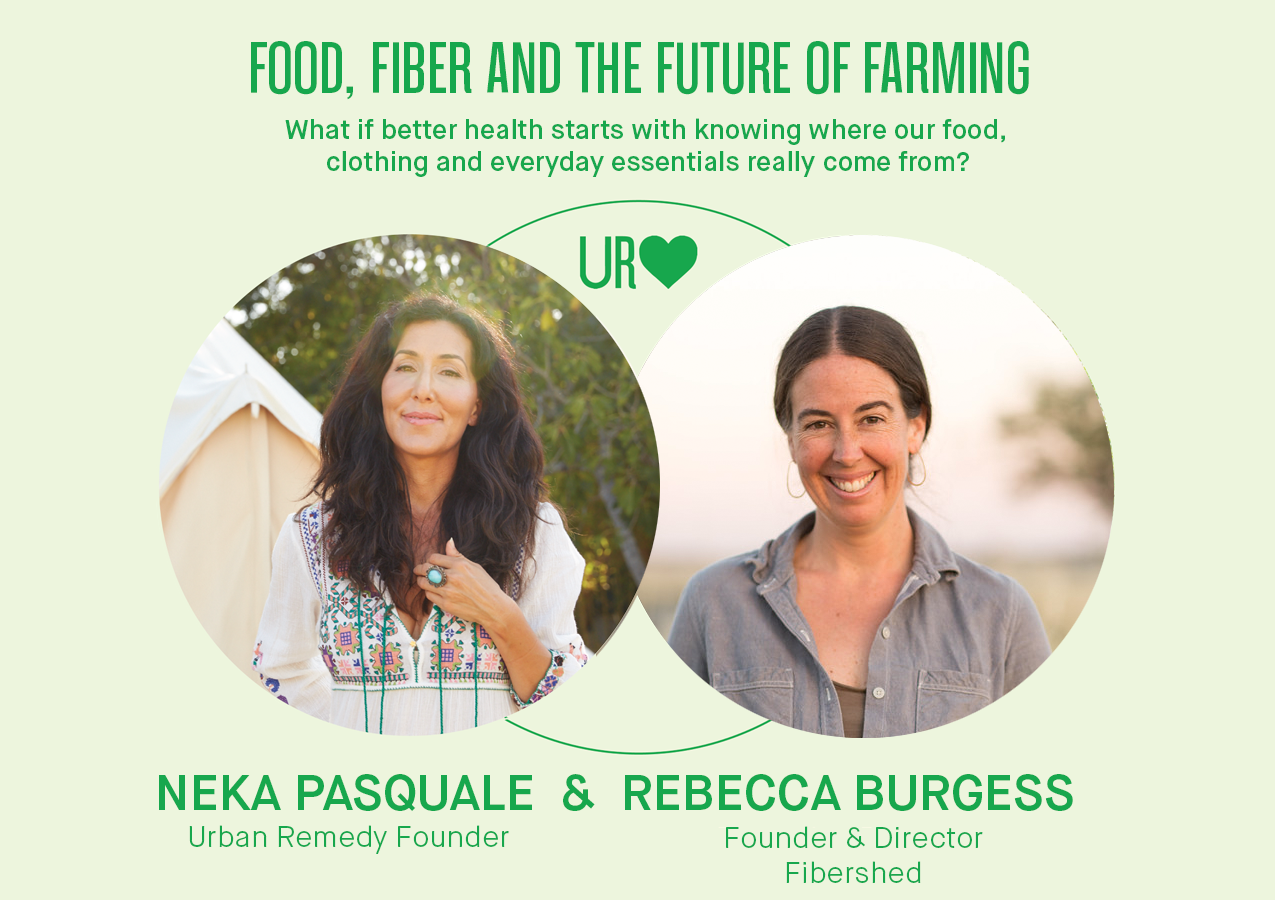
Host: Neka Pasquale, Founder of Urban Remedy
Guest: Rebecca Burgess, Executive Director of Fibershed
Original air date: September 4, 2026
Runtime: 58:17



Episode Summary
Fibershed Executive Director and author Rebecca Burgess joins Neka on the UR Love Podcast to explore the deep connections between the health of our land, our food, the clothes we wear and the communities we call home. From protecting local farmers and rebuilding regional textile systems to reducing our dependence on plastics and industrial agriculture, Rebecca shares why knowing where things come from matters—and how working in harmony with nature can help create healthier, more resilient communities.
What you’ll learn
- Why Rebecca believes food, fiber, farming and human health are deeply interconnected.
- How Fibershed is working to rebuild regional systems for growing, processing and manufacturing natural fibers.
- Why local food systems and relationships with farmers can help create more resilient communities.
- How the needs of a particular landscape should influence what we grow and how we farm.
- Why Rebecca believes agriculture and environmental policy need to account for the differences between individual farms, ranches and ecosystems.
- How wool, hemp and flax could potentially replace some agricultural plastics.
- Why Neka and Rebecca see reconnecting with the natural systems around us as an important response to modern life.
Who is Rebecca Burgess?
Rebecca Burgess is the Executive Director of Fibershed and a leading voice advocating for a shift in how we approach clothing consumption and production.
She serves on the leadership council of the Center for Regenerative Agriculture and Resilient Systems at Chico State University, as Board Secretary for Hukuuiko, a nonprofit serving the Coast Miwok Tribal Council, and on the board of the Carbon Cycle Institute.
Her path to Fibershed began in an unexpected place. Rebecca tells Neka that she initially worked with children with special needs and studied place-based education. She became increasingly interested in the relationship between people, nature, environmental exposures and local ecosystems.
Combined with her training as a weaver and her studies in nature and culture, those experiences eventually led to her work connecting food systems, fiber systems and regional economies.
What is Fibershed?
Fibershed works to build regional textile systems based around natural fibers and the landscapes where those fibers are grown.
Rebecca describes a textile economy in which farmers, mills, dyers, weavers, manufacturers and consumers are more closely connected. Rather than growing fiber in one country, processing it in another and manufacturing clothing somewhere else, Fibershed explores ways to rebuild more of that infrastructure regionally.
Its work includes research and feasibility studies, support for manufacturing infrastructure and financing for businesses working with materials such as wool, natural dyes and vegetable-tanned leather.
Why does Rebecca connect food systems and fiber systems?
For Rebecca, what we eat and what we wear are both agricultural systems.
Food is grown on land and enters our bodies internally. Fibers such as cotton, wool, hemp and flax also begin on farms and ranches and spend much of their useful life directly against our skin.
Yet she believes textiles have received much less attention in conversations about environmental and human health.
The episode explores the idea that many of the same questions should be asked about both food and clothing: Where was it grown? How was the land managed? What inputs were used? Who processed it? How far did it travel? And what happened to the surrounding community and ecosystem along the way?
Why do local food systems matter?
Neka and Rebecca return repeatedly to the importance of knowing where food comes from and developing relationships with the people who produce it.
Rebecca argues that local and regional systems can create greater visibility and accountability because communities can see how land is being managed and understand the ecological conditions farmers are working within.
Neka shares her experience with local organic food systems in Marin County, including school lunch programs that have built direct relationships with nearby farms.
For both women, local food is about more than distance. It is about rebuilding a relationship between eaters, farmers, communities and the landscapes that sustain them.
What does it mean to farm according to place?
One of the central ideas in the conversation is that agriculture should respond to the ecology of a particular place rather than trying to impose one model everywhere.
Rebecca uses the coastal grasslands of West Marin as an example. In landscapes naturally suited to perennial grasses and grazing animals, she argues that well-managed grazing may make more ecological sense than repeatedly tilling the soil to grow row crops.
Different soils, rainfall patterns, water systems and climates support different types of agriculture.
Neka connects this idea to traditional Chinese medicine and its emphasis on observing nature and living in harmony with natural rhythms.
Why do Neka and Rebecca say that “farmers are not a monoculture”?
The phrase comes from Rebecca’s argument that broad labels can obscure important differences between agricultural systems.
A small organic ranch operating within the carrying capacity of a local grassland is very different from an industrial livestock operation dependent on large quantities of imported feed. Likewise, one plant-based farming system can have very different environmental effects from another.
Rebecca argues that farmers, watersheds and food systems should be evaluated according to their particular practices and ecological context rather than being placed into simple categories of “good” and “bad.”
As she puts it in the conversation: farmers are not a monoculture, watersheds are not a monoculture, and neither should our thinking be.
Why is Fibershed interested in rebuilding textile manufacturing in the United States?
Rebecca explains that growing natural fibers is only one piece of a functioning textile system.
Farmers also need places where wool can be washed, cotton can be spun, fibers can be woven or knitted, fabrics can be dyed and finished products can be cut and sewn.
As textile manufacturing moved overseas, many American farmers lost access to those regional processing systems and were left competing in a global commodity market.
Fibershed is working on projects including wool-processing and cotton-spinning infrastructure in California while supporting businesses elsewhere in the United States that are rebuilding pieces of the natural-fiber supply chain.
Why are natural fibers important?
Rebecca believes people should have more alternatives to clothing and textiles made primarily from fossil-fuel-derived synthetic materials.
Fibershed focuses on agricultural fibers including wool, cotton, hemp and flax and on creating systems in which those materials can be grown and processed responsibly.
The goal is not simply to replace one material with another. Rebecca emphasizes considering water, soil, biodiversity, labor and manufacturing together as part of a complete regional system.
Can natural fibers replace plastic used in agriculture?
Rebecca describes one of Fibershed’s experimental projects using lower-value wool combined with shorter flax and hemp fibers to create a natural-fiber composite material.
One possible application is weed suppression.
Plastic sheeting is commonly used in some agricultural and landscaping systems to suppress weeds. Rebecca explains that Fibershed is exploring whether natural-fiber composites could perform a similar function while creating a market for wool and plant fibers that might otherwise have little economic value.
She points to similar natural-fiber systems already being used in parts of Europe and says Fibershed is currently working in prototype mode.
What do Neka and Rebecca discuss as alternatives for vegetation and fire management?
The conversation turns to the use of herbicides in forest and land management and whether grazing animals could play a larger role.
Rebecca describes targeted or prescribed grazing with goats and other animals as one possible land-management tool. Grazing animals can consume vegetation while returning organic matter to the land through manure and urine.
She also explains that economic and labor policies can affect whether targeted grazing is financially practical compared with chemical vegetation management.
The discussion reflects Rebecca and Neka’s broader argument throughout the episode: land-management decisions should consider the complete ecological system rather than solving one problem in isolation.
What can people do to support stronger local food and fiber systems?
One of the simplest actions Rebecca and Neka recommend is getting to know the people producing food in your own region.
Shopping at farmers markets can create a direct connection with growers and provide an opportunity to ask how food was produced. Rebecca also points out that some very small farms may use organic practices even if certification is financially out of reach, making those direct conversations particularly valuable.
Consumers can also ask similar questions about clothing and household textiles: what they are made from, where the raw materials originated and how they were processed.
The larger message of the episode is to become more connected to the systems behind the things we use every day.
How does this conversation connect with Urban Remedy’s Food Is Healing philosophy?
Neka frequently describes health through the lens of traditional Chinese medicine, where human well-being is connected to the surrounding environment.
In this episode, that philosophy extends beyond the ingredients on a plate.
The conversation asks what happens when food, clothing and other everyday materials are produced in ways that work with soil, water, animals, seasons and local communities rather than treating those systems as separate.
For Neka, living in harmony with nature is one of the foundations of Food Is Healing. The discussion with Rebecca expands that idea from personal nourishment to the agricultural and ecological systems that make nourishment possible.
Edited transcript
*This transcript has been edited for clarity and readability. Repeated words, verbal fillers and obvious transcription errors have been removed without changing the substance of the conversation. Where speaker attribution was missing in the source transcript, attribution has been reconstructed from context. The views and personal experiences expressed by the speakers are their own and are provided for general informational purposes, not as medical advice.*
Introduction
Neka Pasquale: Hi, everyone. It’s Neka, the founder of Urban Remedy, welcoming you to the UR Love Podcast, inspiring health, food, lifestyle and making conscious choices.
Neka Pasquale: Today I’m going to be interviewing Rebecca Burgess. Rebecca has more than two decades of experience working at the intersection of ecology, fiber systems and regional economic development.
Neka Pasquale: She is the author of Harvesting Color, a bioregional look into the natural dye traditions of North America, and Fibershed: Growing a Movement of Farmers, Fashion Activists, and Makers for a New Textile Economy, released in 2019.
Neka Pasquale: Rebecca is the Executive Director of Fibershed and serves on the leadership council of the Center for Regenerative Agriculture and Resilient Systems at Chico State University, as Board Secretary for Hukuuiko, a nonprofit serving the Coast Miwok Tribal Council, and on the board of the Carbon Cycle Institute.
Neka Pasquale: That is a very impressive bio. Thank you for being here, Rebecca.
Rebecca Burgess: It’s so great to be here. Thanks for making time.
Neka Pasquale: I’m so excited to talk to you. You’ve been someone in the community who is so inspiring and such a wealth of knowledge for me and for other people I know.
Neka Pasquale: Whenever I have a question about what is happening in West Marin, where glyphosate is being sprayed or how something works with the Forest Service, you seem to understand how a lot of these systems work—which most of us don’t.
Neka Pasquale: I’m really looking forward to learning from you today.
Rebecca’s path to Fibershed
Neka Pasquale: Maybe you could start by telling us how you started Fibershed. What has your journey been?
Rebecca Burgess: I started working with children who were nonverbal and had special needs in my early twenties.
Rebecca Burgess: I’m part of a fifth-generation Marin family. I think you and I are both multigenerational in this county. Questions around development were arising even in the ’80s and ’90s, and my mother was a big proponent of protecting Marin’s wetlands and water systems, maintaining their natural flow and not overdeveloping beyond our ecological carrying capacity.
Rebecca Burgess: I grew up with the idea that we want affordable housing and need to protect working-class communities, but we also need to protect the water.
Rebecca Burgess: We’re in a closed watershed, so that kind of thinking was integral to my childhood.
Rebecca Burgess: Early on, I was also asking: How does one serve and still pay their way? Those are the questions you have in your twenties.
Rebecca Burgess: There were many young people being diagnosed with autism, oppositional defiant disorder, ADD and ADHD. There was a lot of identifying and pathologizing of behaviors that were challenging to manage in classrooms.
Rebecca Burgess: As I gained more skills, I was invited to help children who were having challenges. I earned a credential and eventually a master’s degree in place-based education.
Rebecca Burgess: The thing I found most transformative for many of these young people was time in nature.
Rebecca Burgess: That was my experience as a child too. We didn’t always have a permanent place to live in Marin—it’s expensive—and Mount Tamalpais and the watershed felt like home to me more than whatever apartment we happened to be living in.
Rebecca Burgess: So nature became one of the tools I could draw on in the healing I was trying to facilitate for children.
Rebecca Burgess: I was also learning about environmental exposures because many of the parents were trying to understand what might have contributed to the challenges their children were experiencing.
Rebecca Burgess: At the same time, I was looking at many kinds of supportive modalities: the arts, experiences in nature, movement and ways of working with the nervous system.
Rebecca Burgess: I had gone to UC Davis and studied weaving. I was vocationally trained as a weaver and also had a degree focused on nature and culture.
Rebecca Burgess: All of those influences eventually came together around a question: How can communities develop material culture—food and fiber—within the carrying capacity of our watersheds and foodsheds?
Rebecca Burgess: How can we live healthfully in these places?
Environment, health and individual differences
Neka Pasquale: I never knew that you worked with kids with autism. That’s so interesting.
Neka Pasquale: I know nobody can simply say what causes autism, but were environmental factors something you were thinking about through that experience?
Rebecca Burgess: These things have to be approached carefully. Many relationships are correlations, and proving causality can be difficult.
Rebecca Burgess: I began attending presentations by physicians and pediatricians who were thinking carefully about children’s individual biology and their ability to handle different kinds of stress.
Rebecca Burgess: Vaccination came up in those conversations. The physicians I was listening to were supportive of vaccination, while also talking with parents about timing, frequency and individual differences, including genetic pathways involved in metabolism and detoxification.
Rebecca Burgess: Some parents I worked with believed they had observed behavioral changes in their children following vaccination. I know that is a very controversial issue, but I felt it was important to listen to what mothers and families were reporting while recognizing that their observations do not establish causality.
Rebecca Burgess: Parents were also asking about environmental exposures more broadly.
Rebecca Burgess: Pesticides and herbicides were part of that conversation. Families were trying to reduce potential exposures in their children’s diets.
Rebecca Burgess: It made me start asking bigger questions about agriculture: How are we farming?
Rebecca Burgess: We ingest food internally, but as a weaver I was also thinking about what we wear against our skin.
Rebecca Burgess: That became a major connection for me: How do we reduce toxicity and think about both the food we consume and the materials we wear?
Neka Pasquale: It feels as if that conversation about clothing has become much more visible recently. People are beginning to think about how much workout gear and other clothing is plastic-based.
Neka Pasquale: I also had an acupuncture practice for about ten years in Marin before I started Urban Remedy.
Neka Pasquale: I treated mothers who told me their babies had been developing normally and then became nonverbal following a vaccine. I don’t know whether vaccination caused what they observed, and I don’t think we have a simple answer, but those experiences gave me pause.
Neka Pasquale: Like you, I believe mothers’ experiences deserve to be heard.
Neka Pasquale: Medicine isn’t one-size-fits-all.
Neka Pasquale: Today we have tests that can sometimes help physicians understand how an individual may respond to particular medications. It raises a larger question for me about how we use individualized information when making healthcare decisions, especially with babies and young children.
Marin agriculture and the move toward organic
Neka Pasquale: In terms of California, and West Marin in particular, what did you find when you started looking at our agricultural systems? What has been one of your most important projects working with the land here?
Rebecca Burgess: Marin is pretty blessed.
Rebecca Burgess: The rural economic crisis of the 1980s was driven by policies that encouraged more consolidation of family farms and more monocropping in the name of making things cheaper and more efficient.
Rebecca Burgess: For decades, there had been this idea that economic progress meant moving people off the land rather than supporting diverse agricultural systems.
Rebecca Burgess: Policy increasingly favored automation and consolidation, and the country became more dependent on importing food.
Rebecca Burgess: In the 1980s, that same crisis was closing dairies in Wisconsin, Vermont and parts of California.
Rebecca Burgess: The Straus family saw what was happening and essentially faced a choice: close or differentiate themselves. They chose organic and became pioneers in that transition.
Rebecca Burgess: They built a network of dairies around a model that tried to keep supply aligned with demand and prices relatively stable.
Rebecca Burgess: The decision to vertically integrate and build a creamery also allowed those farms to sell more directly to consumers in Marin and Northern California.
Rebecca Burgess: The entire system could then be managed organically—from grasslands and supplemental feed to the dairy operation itself.
Rebecca Burgess: That model has been extremely important here.
Rebecca Burgess: Very few places in California responded to that rural economic crisis by making a transition like this. It is something we should be proud of and something I hope we continue.
Rebecca Burgess: If California wants more organic agriculture, we also have to build markets that allow growers to find customers willing to support it.
Rebecca Burgess: And we need the infrastructure.
Rebecca Burgess: If we want organic grain, we need grain mills. If we want organic cotton, we need spinning facilities.
Rebecca Burgess: You can’t grow a higher-value organic material, send it across the world to be processed and expect a resilient local agricultural economy to emerge.
Rebecca Burgess: What I want to see in California is a return of agricultural economies that integrate smart technology with human knowledge and ancient wisdom.
Rebecca Burgess: As eaters, wearers and users of natural medicine, we should be able to know where our materials come from.
Rebecca Burgess: There is an intimacy in that relationship that I would love to see reinvigorated.
Protecting local agriculture
Neka Pasquale: We have had some of that in Marin, and because it has existed for so long, I think we sometimes take it for granted.
Neka Pasquale: The open space and agricultural landscape people love here were hard won.
Neka Pasquale: The Straus family and many other thoughtful people were part of that movement.
Neka Pasquale: But it also feels as if we have lost some of that thinking in recent years.
Neka Pasquale: We have been learning more about the use of glyphosate in land management and fire prevention.
Neka Pasquale: Albert Straus’s mother, Ellen Straus, was also one of the founders of the Marin Agricultural Land Trust, MALT.
Neka Pasquale: More recently, I have been trying to understand what has happened with some of the multigenerational organic dairies and ranches in West Marin.
Neka Pasquale: Some ranchers feel they have faced years of litigation without enough support from the surrounding community.
Neka Pasquale: I spoke with a local rancher at the farmers market who was preparing to leave the seashore. I asked what it would take for his family to stay.
Neka Pasquale: His feeling was essentially: nobody protects us.
Neka Pasquale: These are families that have managed this land for generations, yet many people do not know what is happening behind the scenes.
Neka Pasquale: What do you make of that?
Moving beyond simple environmental narratives
Rebecca Burgess: I think part of it comes from California’s history.
Rebecca Burgess: This state was settled through hydraulic mining, deforestation and depletion of fisheries. That is part of our resource history.
Rebecca Burgess: Environmental organizations are responding to real historical damage. There is repair work to be done and reconciliation needed with tribes, fisheries, water systems and many other parts of the landscape.
Rebecca Burgess: All of that is true.
Rebecca Burgess: But then look at an organic cow-calf operation that is grass-fed and grass-finished and does not depend heavily on imported feed or diverted water.
Rebecca Burgess: That is a very different system.
Rebecca Burgess: We have to ask: What can this watershed responsibly hold while still serving salmon, human food needs, perennial grasslands, birds, pollinators and biodiversity?
Rebecca Burgess: In some cases, local ranches are demonstrating a solution rather than creating the problem.
Rebecca Burgess: If we eliminate food production here, we often simply export production somewhere else.
Rebecca Burgess: Then we need to ask what is happening to the watershed, labor and ecosystems in the place we are importing from.
Rebecca Burgess: It is easy to place farms and ranches in our own communities on the chopping block while exporting the environmental impacts somewhere we do not see them.
Rebecca Burgess: Local systems give us intimacy, visibility and accountability.
Why local food matters
Neka Pasquale: That’s what is so frustrating.
Neka Pasquale: Here you can have people who care deeply about the land, water, fish and animals, yet they can get grouped together with entirely different industrial systems.
Neka Pasquale: Why not put more of the attention on factory farming and truly industrial systems?
Neka Pasquale: Community matters too.
Neka Pasquale: What happens if something disrupts our ability to import food? Don’t we want resilient local food systems?
Neka Pasquale: I’m on the board of Conscious Kitchen, which created an organic school lunch program.
Neka Pasquale: One of the beautiful things about the program is that schools can build direct relationships with farms.
Neka Pasquale: If a farmer has too many apples, for example, the school can potentially use those apples the following week.
Neka Pasquale: At my son’s school, we helped transition the lunch program to Conscious Kitchen, and there was a Straus milk dispenser.
Neka Pasquale: The kids were drinking milk produced just down the road.
Neka Pasquale: That was one reason I felt so passionate about protecting the ranches near us.
Neka Pasquale: They were organic, multigenerational operations. And they are part of what people love about West Marin.
Neka Pasquale: You can eat cheese and know the cows were living nearby.
Neka Pasquale: That relationship with a farmer—and knowing where your food comes from—is beautiful.
Neka Pasquale: At Urban Remedy, we don’t have dairy in our products, and we use relatively little meat. That isn’t because I’m anti-dairy.
Neka Pasquale: I understand why people care deeply about the treatment of animals, and I believe animals should be treated well.
Neka Pasquale: But food systems are incredibly complex.
Neka Pasquale: People sometimes assume that a plant-based product automatically has no impact on animal life or ecosystems.
Neka Pasquale: Large-scale monocrop agriculture has impacts too.
Neka Pasquale: There isn’t a simple label that removes us from nature. We have to look at the whole system.
Farming according to the landscape
Rebecca Burgess: Exactly. You have to look at your place.
Rebecca Burgess: It makes sense that a school in our community might serve milk from a local grassland-based dairy because that is the landscape we live in.
Rebecca Burgess: In the coastal hills around Point Reyes, we have grasslands that receive ambient moisture from summer fog.
Rebecca Burgess: We have a rainy season and a very dry season, and that fog helps sustain perennial grassland systems.
Rebecca Burgess: If you repeatedly till those coastal hills for row crops, you introduce a different set of challenges.
Rebecca Burgess: Historically, when potatoes were cultivated extensively in this region, soil erosion contributed sediment to Tomales Bay.
Rebecca Burgess: That is one example of why we have to understand what a landscape can support.
Rebecca Burgess: Row cropping also creates different relationships with underground rodents and predators than grazing systems do.
Rebecca Burgess: When you work with cattle on perennial grassland, those ecological relationships remain very different from repeatedly disturbing soil to establish annual crops.
Rebecca Burgess: We should demystify the differences between row-crop systems and well-managed cow-calf operations.
Rebecca Burgess: We need to think carefully about soil type, precipitation patterns, fisheries, clean water and clean air.
Rebecca Burgess: In our particular area, grass-fed and grass-finished livestock can make ecological sense.
Living in harmony with nature
Neka Pasquale: I think that is something we’re missing as a country.
Neka Pasquale: We have become disconnected from our natural environment and sometimes approach things backwards.
Neka Pasquale: Instead of starting with, “This is the land we live on. This is the climate. These are the seasons. What grows well here?” we decide what we want and then try to force the environment to produce it.
Neka Pasquale: What you’re describing is very similar to the basis of Chinese medicine: How do you live in harmony with nature?
Neka Pasquale: It starts with observation and being in relationship with the land.
Neka Pasquale: There is also an increasing interest in eating according to seasons and natural cycles.
Neka Pasquale: In summer, maybe that means berries, greens and foods that naturally grow in abundance. In winter, the diet traditionally shifts.
Neka Pasquale: At its simplest, wherever you live, you can go to the farmers market and eat more of what is growing in your region at that moment.
Neka Pasquale: Modern life makes it easy to become disconnected from those cycles. We eat food shipped across the world and live under artificial light while barely noticing what season we are in.
Neka Pasquale: And then there is the question of scale.
Neka Pasquale: When we try to scale everything—corn, soybeans, oils, packaged foods—we often need longer shelf life, lower costs and more standardization.
Neka Pasquale: That can pull us further away from the original food and the environment it came from.
Rebecca Burgess: Scale often doesn’t work uniformly across ecosystems.
Rebecca Burgess: You can have a broad principle—for example, that grasslands are suited to animals capable of eating grass—but each place still has its own limitations and possibilities.
Rebecca Burgess: The industrial corn and soy systems used to feed concentrated animal operations are very different from the grass-based systems we are talking about here.
Rebecca Burgess: That distinction matters.
Rebecca Burgess: Farmers are not a monoculture.
Rebecca Burgess: Watersheds are not a monoculture.
Rebecca Burgess: How we eat should not be a monoculture.
Rebecca Burgess: And our thoughts should not be a monoculture.
Rebecca Burgess: When we reduce everything to “all cows are bad,” for example, we lose the ability to understand those distinctions.
Food, agriculture and community
Neka Pasquale: That nuance is really important.
Neka Pasquale: When decisions about local land are made without the people who have lived and farmed there for generations, we can end up replacing one system without understanding everything that system was doing.
Neka Pasquale: You remove animals, for example, and then may discover those animals were also helping manage vegetation and soil.
Neka Pasquale: Suddenly you need to bring grazing back in or use another management tool.
Rebecca Burgess: That is one of my biggest concerns.
Rebecca Burgess: Land management has ecological consequences, but it also has economic and cultural consequences.
Rebecca Burgess: We should look at all of those together.
Rebecca Burgess: When you remove local farmers or ranchers, you don’t simply change what is happening on one piece of land.
Rebecca Burgess: You change our society’s relationship with agriculture.
Rebecca Burgess: California has enormous areas where ecological repair is needed.
Rebecca Burgess: My question is: Where can public resources create the greatest improvement, and where do we already have systems that are functioning relatively well?
Connecting with your own food system
Neka Pasquale: One thing I would reiterate for people listening, wherever you live, is that it is so important to connect to your local food system and understand where your food comes from.
Neka Pasquale: You need to know who the farmers in your region are.
Neka Pasquale: Small farmers do not always have the resources or public voice that larger companies and organizations have.
Neka Pasquale: And sometimes people don’t realize what is happening until a local farm is already gone.
Neka Pasquale: We could do an entire other podcast about that.
Neka Pasquale: But I also want people to understand Fibershed.
Neka Pasquale: What does Fibershed actually do, and why do we need it?
Why Fibershed?
Rebecca Burgess: The conversation around what we wear—what we dry our bodies with after a shower, what we sleep in and what we clothe ourselves with—has been underrepresented in discussions about toxicity, planetary health and human health.
Rebecca Burgess: Trade agreements and globalization also reshaped that system.
Rebecca Burgess: When environmental regulations required American dye houses to make significant improvements, many manufacturers ultimately moved production elsewhere rather than reinvesting in those facilities here.
Rebecca Burgess: We exported some of the environmental problems instead of solving them.
Rebecca Burgess: When dye houses and manufacturers left, an entire ecosystem followed.
Rebecca Burgess: American farmers lost access to spinning mills, weavers and cut-and-sew operators.
Rebecca Burgess: Suddenly, a farmer producing wool or cotton in the United States had to compete directly in global commodity markets against producers operating under completely different labor and environmental conditions.
Rebecca Burgess: Environmental regulation is important.
Rebecca Burgess: But when you put strong environmental standards in place, you also need to make sure growers have access to markets and manufacturers that can support the cost of meeting those standards.
Rebecca Burgess: Otherwise, growers go into debt and eventually sell their farms.
Rebecca Burgess: Fibershed is trying to interrupt that process.
Rebecca Burgess: We need spinning facilities and other infrastructure.
Rebecca Burgess: Automation can absolutely be part of that.
Rebecca Burgess: The goal is to keep growers producing natural materials in ways that support healthy landscapes while giving people alternatives to wearing fossil-carbon-based synthetic materials and unnecessary chemical finishes.
Rebecca Burgess: Fibershed works on feasibility studies and factory floor plans.
Rebecca Burgess: I also advise a financing initiative that provides grants and lower-interest capital to businesses working in areas such as vegetable-tanned leather and natural dyes.
Rebecca Burgess: There are businesses rebuilding leather cutting and sewing infrastructure and other parts of the natural-fiber economy.
Rebecca Burgess: Nationally, we work around finance and business development.
Rebecca Burgess: Regionally, some of our big projects include establishing wool washing in California and developing cotton-spinning capacity.
Rebecca Burgess: And I believe we can do all of this while also supporting healthy fisheries.
Rebecca Burgess: We do not have to sacrifice salmon in order to have wool or cotton.
Rebecca Burgess: We have looked at water use, arable land, wetlands and which areas can reasonably stay in agricultural production.
Rebecca Burgess: These systems can coexist if we design them thoughtfully.
Rebuilding regional economies
Neka Pasquale: It sounds so similar to what we were discussing with food.
Neka Pasquale: Are all of our clothes going to be shipped halfway around the world from manufacturing systems where people may be paid very little and where American farmers have no realistic way to compete?
Neka Pasquale: Or can we support local and regional communities?
Neka Pasquale: You have the textile maker, the person sewing, the weaver and the farmer.
Neka Pasquale: It sounds idyllic, but it also sounds incredibly simple.
Neka Pasquale: It is how humans lived for a very long time—smaller communities where people supported each other.
Neka Pasquale: The goal wasn’t necessarily how much you could scale. It was also what you brought to the community.
Rebecca Burgess: And interestingly, some of the countries with strong textile traditions recognize the quality of California-grown fibers.
Rebecca Burgess: Japanese textile makers buy California cotton.
Rebecca Burgess: Italian mills buy California cotton.
Rebecca Burgess: They look at what some of our farmers grow and see some of the highest-quality material in the world.
Rebecca Burgess: If those textile economies can value what California farmers produce, why can’t California build more capacity to use it here?
Agricultural plastic and natural-fiber alternatives
Neka Pasquale: You were telling me recently about farmers using plastic on the land and about the possibility of replacing some of it with fiber.
Neka Pasquale: I didn’t really understand what you meant. Can you explain that?
Rebecca Burgess: Think about strawberries and other row crops.
Rebecca Burgess: Even in some organic systems, plastic can be used for weed suppression.
Rebecca Burgess: In California, we are also one of the largest wool-producing states, but we have very limited infrastructure for washing and processing that wool locally.
Rebecca Burgess: Some wool—particularly wool from areas such as the belly of the sheep—doesn’t have the quality needed for clothing.
Rebecca Burgess: It may contain more dirt, vegetable matter or other contamination.
Rebecca Burgess: But that lower-value wool can potentially be used in composite materials.
Rebecca Burgess: We’ve been experimenting with combining wool with the shorter fibers left from flax and hemp processing.
Rebecca Burgess: Those shorter fibers might not be suitable for fine linen or hemp textiles, but they can potentially be blended with wool into a composite material.
Rebecca Burgess: In Austria, there are examples of waste wool and plant fiber being used to create materials for land restoration and weed suppression.
Rebecca Burgess: That creates the possibility of replacing some plastic products used on farms and in landscaping.
Neka Pasquale: What does the plastic use actually look like?
Rebecca Burgess: Growers or landscapers may roll sheets of plastic down a row and create openings where they want the crop to grow.
Rebecca Burgess: The plastic suppresses weeds around the plant.
Rebecca Burgess: But plastic can degrade over time, fragment and remain in the environment.
Rebecca Burgess: So we are interested in creating something made from natural materials that can perform the weed-suppression function without creating the same long-term plastic waste.
Rebecca Burgess: We are still in prototype mode, but similar approaches are already being used in parts of Europe.
Rebecca Burgess: If a natural-fiber suppressant reduces some of the labor required for weeding while also creating value for agricultural fibers that otherwise have little market, that could be very interesting.
Rebecca Burgess: I’m also personally a fan of people getting outside and weeding. It’s good for you.
Forest management, herbicides and grazing
Neka Pasquale: I know we don’t have much time left, but on a related note, I’ve been learning about glyphosate being used in California forests and other areas as part of vegetation and fire management.
Neka Pasquale: I’ve also heard concerns that killing and drying vegetation could potentially leave dry biomass behind.
Neka Pasquale: What do you see as alternative ways of managing fire risk?
Rebecca Burgess: After major fires in California, a tremendous amount of vegetation can regenerate.
Rebecca Burgess: Forest managers then have to think about how to manage that biomass.
Rebecca Burgess: One method is herbicide application.
Rebecca Burgess: My concern is that when vegetation is killed and dried in place, you still have dry material on the landscape.
Rebecca Burgess: An alternative tool we could invest more heavily in is grazing.
Neka Pasquale: Why aren’t we using more goats? There are goat-grazing operations around here that can clear vegetation with animals.
Rebecca Burgess: Exactly.
Rebecca Burgess: Goats eat that biomass and return manure and urine to the soil.
Rebecca Burgess: With skilled shepherding, grazing can be very targeted.
Rebecca Burgess: There are now virtual fencing systems that can help keep animals away from particular trees or sensitive areas.
Rebecca Burgess: It’s called prescribed or targeted grazing because it can be managed intentionally.
Rebecca Burgess: But there is an economic side to this too.
Rebecca Burgess: California labor rules and the way overtime requirements apply to herders can have a very large effect on the cost of grazing operations.
Rebecca Burgess: Herders often live with the animals during grazing jobs, which makes the structure of their work very different from many other agricultural jobs.
Rebecca Burgess: Housing and other support may also be included for workers brought in through agricultural visa programs.
Rebecca Burgess: If the labor structure makes targeted grazing dramatically more expensive than chemical vegetation management, grazing businesses can become economically unviable.
Rebecca Burgess: We need policies that protect workers while also recognizing the realities of different kinds of agricultural work.
Rebecca Burgess: Otherwise, we make it harder to use animals as a land-management tool.
What listeners can do
Neka Pasquale: For someone listening who doesn’t want certain land-management practices happening where they live, what can they do?
Neka Pasquale: How can people become better informed about their own local food systems, landscapes and communities?
Rebecca Burgess: If people are concerned about land-management practices in their region, one thing they can do is communicate directly with elected officials.
Rebecca Burgess: In California, people who support targeted grazing can let policymakers know that they want labor policy structured in a way that allows responsible grazing businesses to continue operating.
Rebecca Burgess: They can also communicate their views about herbicide use on public lands.
Rebecca Burgess: For people who want to learn more about our side of these issues, they can follow Fibershed.org.
Rebecca Burgess: Most of what we do through our communications is simply tell the personal stories of farmers and people working within these systems.
Rebecca Burgess: There are also local organizations focused on particular land-management issues, so people can learn what is happening where they live and participate where appropriate.
Vote with your dollar—and know your farmer
Neka Pasquale: And shop at your local farmers market.
Neka Pasquale: Get to know your farmers.
Neka Pasquale: There are farmers who may not be able to afford organic certification but still grow without certain chemical inputs.
Neka Pasquale: Certified organic is incredibly valuable because there is a defined standard behind it.
Neka Pasquale: But if you know a small farmer personally, you can also ask how they grow their food and even visit the farm.
Neka Pasquale: Maybe the future is that we actually know each other.
Rebecca Burgess: Exactly.
Neka Pasquale: Ultimately, I wish organic were simply the norm.
Neka Pasquale: Imagine if instead of the burden being on an organic farmer to tell you that food was grown differently, the label had to tell you when certain chemicals were used.
Neka Pasquale: Our system works almost in reverse right now.
Neka Pasquale: But maybe that can change.
Closing
Neka Pasquale: Thank you so much, Rebecca, for all the incredible work you do.
Neka Pasquale: For people who want to learn more about Rebecca’s work, you can go to Fibershed.org. What’s your Instagram?
Rebecca Burgess: Fibershed underscore.
Neka Pasquale: Fibershed underscore. Thank you so much, Rebecca.
Rebecca Burgess: Thank you for all that you do. This was so fun.
Neka Pasquale: Thank you for joining us on the UR Love Podcast. For more episodes like this, please subscribe.
Neka Pasquale: This is Neka, and I’m wishing you a beautiful day.