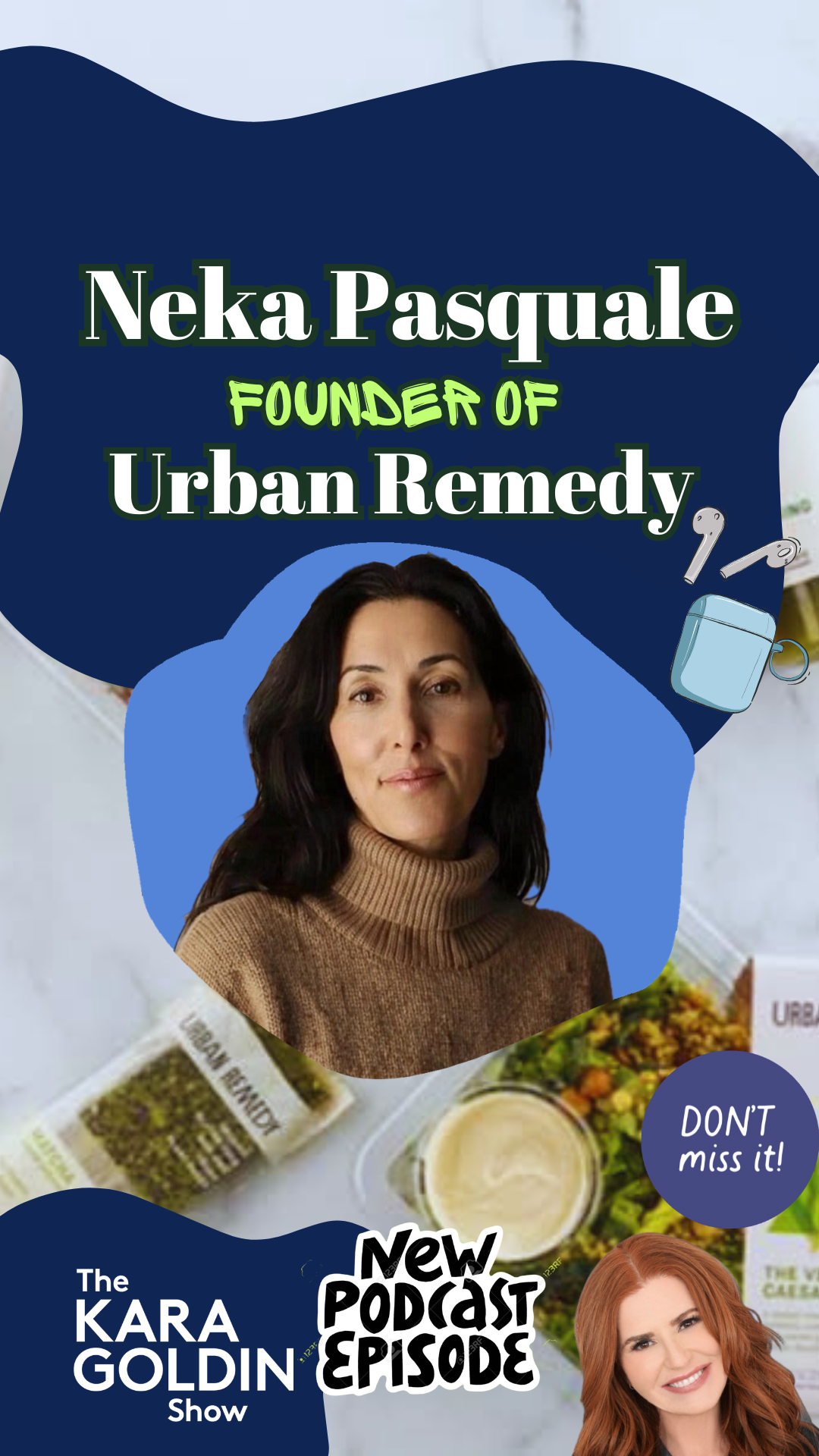
Episode: 877
Podcast: The Kara Goldin Show
Host and publisher: Kara Goldin
Guest: Neka Pasquale, Founder and Chief Product Officer of Urban Remedy
Original air date: August 12, 2026
Runtime: Approximately 31 minutes


Episode Summary
Urban Remedy founder and Chief Product Officer Neka Pasquale joins Kara Goldin to share how her background in acupuncture, traditional Chinese medicine and nutrition inspired a company built on one enduring belief: Food Is Healing. Neka discusses growing Urban Remedy from a small Marin County business into a national organic food and beverage brand, the challenge of scaling fresh food, and why she believes founders must protect their values as their companies grow. She also explains how Urban Remedy approaches organic sourcing, minimally processed ingredients, product innovation and convenient food for modern life.
What you’ll learn
- How Neka’s work as a healthcare practitioner inspired Urban Remedy and its Food Is Healing philosophy.
- Why certified organic sourcing, colorful whole foods and minimally processed ingredients remain central to the brand.
- What Neka learned while growing a local fresh-food business into a national company.
- How Urban Remedy evaluates food trends and develops new products without losing its identity.
- Why Neka believes the future of food should begin with healthier soil and simple, whole ingredients.
What makes Urban Remedy different?
Guided by the belief that Food Is Healing, Urban Remedy offers organic, ready-to-eat foods and beverages crafted to be nourishing, delicious and convenient. Our recipes are thoughtfully made with minimally processed, plant-forward ingredients.
What makes Urban Remedy different is how those priorities come together. Our products emphasize colorful vegetables and fruits, plant-based proteins, nuts, seeds, whole-food fats, herbs and spices commonly included in an anti-inflammatory eating pattern. They are also gluten-free, dairy-free and non-GMO, and made without refined sugar, artificial additives or industrial seed oils—making it easier to choose real, nourishing food, even on busy days.
Urban Remedy is available at Whole Foods Market and through Whole Foods Market on Amazon.
Learn more about Urban Remedy’s story and Food Is Healing philosophy.
Why is certified organic important to Urban Remedy?
Neka sees organic sourcing as beneficial to both people and the food system. She explains that choosing certified organic food supports farms operating under standards that restrict substances such as glyphosate and prohibit methods including genetic engineering and sewage sludge.
USDA organic certification is governed by specific production, handling and labeling requirements. According to the USDA, certified organic production is designed to foster resource cycling, promote ecological balance, conserve biodiversity and minimize the use of synthetic materials. Learn more from the USDA’s organic labeling guidance and its explanation of allowed and prohibited substances.
How did Neka grow Urban Remedy without losing its founding vision?
Neka began Urban Remedy as a small local business intended to make clean, organic food more accessible to people in her community. As demand grew, she learned procurement, operations and leadership on the job. Her biggest lesson for other founders is that experience does not eliminate the learning curve: building something new requires mistakes, adaptation and a team whose strengths complement your own.
Growth also created pressure to follow trends and make decisions based solely on scale. Neka says the founder’s role is to keep protecting the company’s purpose and “immutables,” particularly after bringing in investors and experienced executives.
How does Urban Remedy approach product innovation?
Urban Remedy listens closely to customers and retail partners while evaluating every new idea through our established standards and guiding principle: every ingredient should be HEALING, NOT HARMFUL. New products are developed to be nourishing, delicious and convenient, prioritizing organic, minimally processed and plant-forward ingredients.
We stay open to relevant consumer needs, such as the demand for higher-protein meal replacements, but we do not believe every trend belongs in the Urban Remedy portfolio. Innovation must answer a genuine customer need while remaining recognizably Urban Remedy.
Recent examples include Urban Remedy’s Chocolate Protein Collagen Meal Shake, Vanilla Protein Collagen Meal Shake and Strawberry Protein Collagen Meal Shake. She also discusses enduring customer favorites such as the Turmeric-Relieve Shot.
For us, innovation is not about chasing what is new. It is about thoughtfully meeting evolving needs without compromising who we are: organic where certification is possible, made with carefully selected ingredients and always guided by the belief that Food Is Healing.
What does Neka believe about the future of food?
Neka believes progress should begin with restoring soil health and making simple, colorful, whole food more accessible. While much of the “future of food” conversation centers on technology and laboratory-made alternatives, she remains skeptical of products that depend on extensive processing. Her vision is rooted in the wisdom of nature, organic and regenerative agriculture, and food kept as close as practical to its natural state.
Transcript
*This transcript has been edited for clarity and readability. Repeated words, verbal fillers and obvious transcription errors have been removed without changing the substance of the conversation. Timestamps are approximate. The views expressed by the speakers are their own and are provided for general informational purposes, not as medical advice.*
Introduction
Kara Goldin (0:00): I am unwilling to give up. I will start over from scratch as many times as it takes to get where I want to be. You will get knocked down, but make sure you don’t get knocked out. Focus on what you can control.
Hi, everyone, and welcome to The Kara Goldin Show. Join me each week for inspiring conversations with some of the world’s greatest leaders. We’ll talk with founders, entrepreneurs, CEOs and some of the most interesting people of our time. I can’t wait to get started. Let’s go!
Hi, everyone, and welcome back to The Kara Goldin Show. The food industry talks a lot about health, but every once in a while, someone builds a brand from a much deeper belief: that food is not just fuel; it can actually be healing. And that’s Neka Pasquale.
Long before clean, organic and anti-inflammatory eating became part of the mainstream conversation, Neka was working with patients through acupuncture, Chinese medicine, nutrition and lifestyle changes, helping people heal and feel better from the inside. In 2009, she founded an incredible company called Urban Remedy with a simple but powerful mission: to reimagine the food system and teach the world that food really is healing.
Today, Urban Remedy offers clean, convenient, freshly prepared meals, snacks, cold-pressed juices and shakes. The brand has grown significantly from its roots in the Bay Area and is now national. I’m looking forward to speaking with Neka about building a brand around a healing philosophy. It’s so nice to meet you, Neka.
Neka Pasquale (2:15): Nice to meet you too. Thank you.
Building a brand around Food Is Healing
Kara Goldin (2:17): For listeners who are just discovering Urban Remedy, how do you describe the brand? What makes it different from other wellness or prepared-food brands?
Neka Pasquale (2:31): One of our biggest differentiators is that we’re certified organic, so I love to start with that. We make minimally processed, fresh food, including salads and bowls with a shorter shelf life. We cover all dayparts, with breakfast, lunch, dinner, snacks, juices and shots.
I craft everything to support an anti-inflammatory diet or offer functional benefits, really utilizing the simplicity of food’s innate healing power. In Chinese medicine, every ingredient has a taste, temperature and medicinal property, so I try to make balanced and delicious offerings for people. We have a Booster Shot and a Turmeric-Relieve Shot with pineapple, turmeric, cayenne and ginger. I like to tune into the properties of foods and incorporate them into products that taste good and make you feel good.
Another part of Urban Remedy that I love is educating people about organic agriculture. Every time you choose organic and support organic farms and companies, you’re helping create land that you know is not being sprayed with glyphosate. There are so many benefits to supporting organic.
Kara Goldin (4:17): You built Urban Remedy around the belief that food is healing. When you started, did you feel anyone else was doing this with authority?
Neka Pasquale (4:33): I don’t think so. I had mentors in acupuncture school and during the first few years of my practice who educated me about looking at the energetics of food. Food grown in organic, mineral-rich soil is different from food grown in depleted soil. That was before regenerative farming was really part of the conversation, and now we’re seeing more focus on it.
There wasn’t a company at that point really looking at food as healing. In my practice, I was seeing how many chronic inflammatory conditions were related to diet. I thought that if people changed their diet, that could be an important piece of the puzzle in regaining their health, along with other things.
From a local idea to a national company
Kara Goldin (5:32): Did you ever think you would build a company with physical locations and products extending beyond drinks into food nationwide? Did you have that vision from the start, or did you want to solve a problem for patients and consumers and see where it went?
Neka Pasquale (6:03): Initially, it was just local here in Marin. I thought I would do it as a side project, and then people started loving it. Someone called me and wanted to invest at the perfect time, so it all fell into place.
I started with a little store in San Rafael, and we grew out of it within six months. I thought we were going to be there forever. We’ve steadily grown over the years, and now we’re national. I never imagined having our own branded kiosks in Whole Foods Market. I was doing this for local people who wanted clean, organic food that was easy and convenient.
Kara Goldin (7:00): Let’s go back to those early days in 2009. We have many entrepreneurs and aspiring entrepreneurs listening who might look at your company today and think you must have had lots of experience or known exactly how to get into Whole Foods Market or open a store. What did those early days in San Rafael actually look like?
Neka Pasquale (7:39): I had no experience in this industry. I had experience running a business because I had my own acupuncture practice, and I had worked since I was 16, so I had some business sense. But when Urban Remedy started going gangbusters, I was the CEO and also handled procurement. I had zero experience with many of those things.
During the first few years, I made so many mistakes and learned from them. It was fun and exciting because I was learning how things worked and how to grow. Once you find your rhythm, make a bunch of mistakes and get on the right track, it’s so fun.
Even with a master’s in traditional Chinese medicine and acupuncture, I wasn’t totally prepared to start a practice. The same is true for any business unless you’ve worked in that industry before. There are so many facets of a business, and you can’t be good at everything. If your business takes off, it’s important to surround yourself with experienced people who are really good at what they do.
Protecting the founder’s vision
Kara Goldin (9:03): In the early days of launching Hint, I kept thinking I had to bring experienced people in and they would wave a wand and make everything easier. What I didn’t realize was that starting a company from ground zero is very different from coming from a $100 million or billion-dollar company. Did you have moments when you thought new hires would solve the problem, but realized that much of it was learning and making mistakes?
Neka Pasquale (9:46): Totally. When I hired my first CEO, I thought it was going to make my life so much easier. But when you start a business that is your baby and a little more niche, your vision guides it because you created it and believe in it.
We have so many people at Urban Remedy who believe in our mission and vision and are aligned with what we’re doing. But after all these years, I still feel like I’m the person who holds that vision. That’s especially important when you take investment, because investors want the business to grow and reach a certain place. Along that path, it’s easy to make business decisions that might not align with how you see the company. It’s critically important to keep holding the vision, because the business can easily go sideways if you don’t.
Creating products people rely on
Kara Goldin (11:03): When you expanded beyond the San Rafael store, was there a product or offering that made you feel the company was going to make it and that people were really paying attention?
Neka Pasquale (11:25): We were doing juice cleanses before they became common, so those were very popular. Then I started making many food items, snacks and shots. Looking back, I did a lot. At one point, we had about 100 SKUs. If I were talking to my younger self, I would say to focus on less complexity.
People also want differentiation and seasonal products. Offering all the dayparts is helpful because someone can have an Urban Remedy shake for breakfast, a salad for lunch, and then a dessert or a shot. We try to provide that because many people don’t know how to eat this way, and our recipes can be complex. Buying all the ingredients and making them at home would take time and could be expensive.
People become passionate about their favorite items. Our Matcha Bar was out of stock for a while, and people emailed me saying it was the one thing they couldn’t live without and that they looked forward to it every morning. Customers have different favorites, including our Matcha Bars, chia puddings, shots and meals.
Keeping ingredients simple
Kara Goldin (13:13): Anti-inflammatory eating is discussed much more now, but it wasn’t mainstream when you started. How did you educate people without being in front of them?
Neka Pasquale (13:33): When we first launched into Whole Foods Market kiosks, I wasn’t sure because I hadn’t pictured Urban Remedy that way. My CEO at the time told me it was a way to get this food to more people. If my goal was to reach as many people as possible through food, it made sense, and my thinking changed.
My philosophy around food has not changed very much. We offer simple food designed to support an anti-inflammatory diet. That means colorful food, with different herbs, fruits and vegetables rich in naturally occurring antioxidants and phytonutrients. When you keep food as close as possible to its natural state, it generally has higher water content and can have a lower glycemic index.
Someone recently suggested adding a functional powder to a salad dressing. I said our salad dressings are simple, and that is part of their beauty. Olive oil naturally contains polyphenols. We don’t use canola, soy or corn oil. We use olive oil, apple cider vinegar, garlic and fresh herbs. We don’t need to tell a different story. Adding functional powders would make it more processed. We should celebrate the beauty and simplicity of the ingredients. That is my philosophy.
Innovating within the Urban Remedy framework
Kara Goldin (15:22): Retail chains always want something new. How often are you developing new products versus continuing to focus on the core?
Neka Pasquale (15:45): I’m constantly developing new things. Whole Foods Market loves newness and innovation, but I try to keep it within the framework of what Urban Remedy already does. We change salads and shots because people want something new. I look at the set and ask what isn’t selling well and what we can replace it with that would make more sense.
I try not to follow trends too much, but we recently launched high-protein chocolate, vanilla and strawberry shakes, and they’re doing very well. They have up to 30 grams of protein. I pay attention to what people are looking for, but I keep it in the Urban Remedy format.
Kara Goldin (16:38): The shakes are so good. What are some of the most popular items lately? Has anything surprised you with its popularity?
Neka Pasquale (17:00): The shakes are very popular, and I’m not surprised because people had been asking for higher-protein shakes. I think they taste really good. They also contain collagen. I’m proud of them. They’re made with thoughtfully selected ingredients and are a great meal replacement.
Our Turmeric-Relieve Shot continues to be a bestseller. Some products have more seasonality: immunity shots generally do well during cold and flu season, while lighter juices and lemonades do well in summer. I’m a big fan of eating with the seasons and offering seasonal products. The Matcha Bar is one of the top three most beloved products. People lose it when we’re out of stock.
Creating a convenient “food safe zone”
Kara Goldin (18:07): As you’ve scaled across the country, have you seen geographical patterns? Has moving into the middle of the country been more difficult, or is it exciting to see eating patterns develop there?
Neka Pasquale (18:30): Our bestselling salads include the Vegan Caesar and Macro Bowl, and that is consistent wherever we are. The wellness-shot category has become saturated, so you have to communicate how your product is different, whether that’s certified organic status or the ingredients.
Once people find Urban Remedy, I describe it as a food safe zone. You can go there knowing you won’t find industrial seed oils, white sugar, white flour or highly processed foods. At Whole Foods Market, it’s a place where you don’t have to read the label as closely because you know it won’t contain those ingredients. I’m proud of that because we receive that feedback from customers.
We’re in a few hospitals, and people tell us it’s great to have this kind of food while they’re there. Others take it on airplanes or when traveling somewhere with fewer nourishing options. This summer, people texted me that they brought Urban Remedy food to Disneyland with their kids. They could get it out of the refrigerator and have their own food ready.
Kara Goldin: That would be amazing. Do you see Urban Remedy going into Disney in the future?
Neka Pasquale: We looked at that a few years ago and spoke with them. I don’t remember what happened, but they have a complex food system and process for choosing everything. It would be very cool. I took my son to Disneyland a few years ago and brought all my own food.
It’s great to be in places where people have fewer options. I was on another podcast recently with someone who lives in Tennessee but is from here. She said it was great to find us in her local Whole Foods Market because there wasn’t as much food like it nearby.
The challenge of scaling fresh food
Kara Goldin (20:44): Fresh food is very different from building a shelf-stable brand. What have been some of the biggest operational challenges?
Neka Pasquale (20:55): Freshness is the challenge. Almost nobody scales fresh food the way we do. Once you cut and chop something, it can start to oxidize, so the shelf life is much shorter.
Balancing fresh food with a shorter shelf life while minimizing waste is very difficult. We create this beautiful organic food, and if we have a high purge rate, we lose money and throw food away. Compare a product with a six-month shelf life to one with a seven- or eight-day shelf life. Maintaining the right inventory and minimizing shrink are incredibly important. That has always been our biggest challenge.
Kara Goldin: How much of product development at Urban Remedy is data versus your own instinct?
Neka Pasquale: Most of it is my own instinct. Occasionally, someone in a meeting will say that Starbucks launched something that is selling well. I have to hold the space and say that we are not Starbucks and we’re not going to copy Starbucks. Whatever we do, even within a big trend, has to be done in the Urban Remedy style.
With the protein shakes, for example, we asked how we could stay true to our values. They fit within our immutables. Anything I develop has to fit within those standards.
I may be less of a trend follower than some of the people I work with, but I understand why trends matter when you want to increase sales. There is a balance. People have come up to me at Expo and said they started a food company because Urban Remedy inspired them to do something nourishing. That makes me feel so good. As a founder, you really do have to hold space for your values and the way you do things, because it’s easy to lose your way.
Separating meaningful trends from noise
Kara Goldin (23:49): The food industry is constantly seeing trends: juice cleanses, plant-based and functional foods, protein, collagen and creatine. How do you decide what is real and what is noise?
Neka Pasquale (24:16): Looking through the lens of a healthcare practitioner and having been in the natural-health world for so long makes it easier for me to identify things that meet those standards.
It’s exciting when ingredients we’ve used for a long time suddenly become trends, such as turmeric, spirulina or chlorophyll. They have been in my toolkit for a long time. If something is offered in a highly processed form, I’m skeptical because, in general, the more you process a food, the further it gets from its original form.
We have added supplements such as vitamin C or probiotics to some shots, but I use the lens of my healthcare background: Would I have used this with a patient, and what do I think about it? Sometimes an ingredient is interesting but isn’t right for everybody because people have different constitutions.
In Chinese medicine, herbs are often used in formulas so they can be balanced and tailored to a person’s constitution. For a broadly available product, I ask whether an ingredient is appropriate for the majority of people and how we can keep its benefits more neutral and widely applicable.
Supporting organic agriculture
Kara Goldin (26:17): What ingredients or developments are you most excited about today? Is there something you’re glad to see becoming more mainstream?
Neka Pasquale (26:32): The main thing is eating certified organic food. When you buy organic, you know the soil is not being sprayed with herbicides containing glyphosate. With increased spraying in forests and communities, that is important. The more organic and regenerative farmland we have, the less exposure there is for farmworkers and communities. For me, being certified organic and supporting organic farmers by voting with your dollars are critical.
The product I’m really excited about is a new coconut yogurt that we hope to launch in September. It’s so delicious. We haven’t made a yogurt before, so I’m very excited to launch it.
The future of food
Kara Goldin (27:35): When you think about the future of food, what are we still not talking about enough? As a health practitioner and the founder of a company that has scaled, what are you most excited about?
Neka Pasquale (28:18): When people talk about the future of food, the conversation often centers on incorporating technology into everything: lab-grown food, lab-grown meat or highly processed ingredients intended to feed everyone.
I believe in nature and the wisdom of nature. For me, the future of food is about healing our soils and eating colorful, vibrant food in its natural state. I don’t believe something grown in a lab will necessarily be better than what nature has already created.
How do we keep celebrating beautiful, simple, whole food? We don’t need to ultra-process something to make it new and different. Some highly processed brands that emerged over the last decade grew quickly and then faded because the products were driven by novelty. I’m interested in real, whole food. That’s why I started Urban Remedy, and I will continue to hold that viewpoint.
People are always trying to identify the next thing or figure out how to change food. I think we also need to consider whether those changes truly serve people’s well-being.
Closing
Kara Goldin (30:27): And the planet as well. Neka, thank you so much for joining me today. I love your company, your products and your story. You saw what was possible long before the market caught up, and you built Urban Remedy around standards that I truly appreciate.
For everyone listening, you can learn more about Urban Remedy and find its products. Thank you again, Neka Pasquale, founder of Urban Remedy.
Neka Pasquale: Thank you.
Kara Goldin: Thanks again for listening to The Kara Goldin Show. Please give us a review and share this podcast with others who would benefit. Subscribe so you don’t miss an episode. I can be found on all platforms at Kara Goldin, and I would love to hear from you, so feel free to send me a direct message.
If you want to hear more about my journey, I hope you’ll listen to or pick up a copy of my Wall Street Journal bestselling book, *Undaunted*, where I share more about my journey, including founding and building Hint. We’re here every Monday, Wednesday and Friday. Thanks for listening, and goodbye for now.
